The phrase covers a wide spectrum. At the simple end, an Industry 4.0 CNC maskine might just publish its run-state (cutting, idle, alarm) to a shop-floor dashboard. At the sophisticated end, the same machine sits inside a closed loop where MES schedules its jobs, ERP receives its output counts in real time, predictive maintenance triggers from spindle current trends, and quality data from in-process inspection feeds back into the next program. Both ends qualify as Industry 4.0; they differ in maturity, not in kind.
What distinguishes Industry 4.0 CNC machining from a stand-alone CNC machine is connectivity and context. A traditional CNC machine runs a program and produces parts. An Industry 4.0 CNC machine does the same thing while also generating a continuous data stream that the rest of the factory can use to schedule work, predict failures, measure performance, and improve quality.
The Industry 4.0 Architecture: From Sensor to ERP
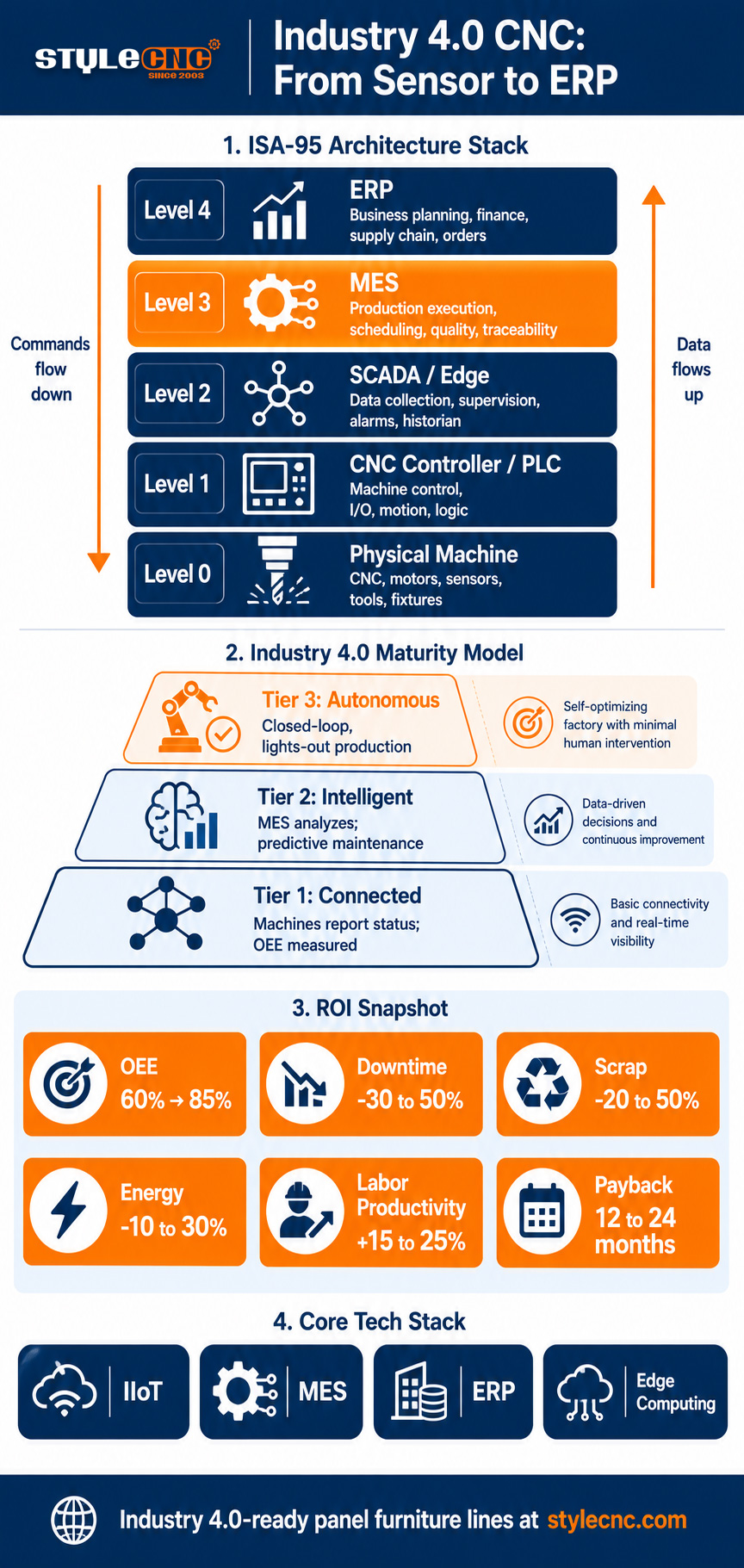
The dominant architecture for Industry 4.0 CNC machining follows the ISA-95 standard, which defines 5 hierarchical levels of manufacturing control. The diagram below shows how data flows up the stack from physical sensors to enterprise systems, while commands and schedules flow down in the opposite direction.
LEVEL 4 ERP / Business Planning
Scheduling, inventory, finance
LEVEL 3 MES / Manufacturing Operations
Production tracking, OEE, traceability
LEVEL 2 SCADA / Edge Computing
Data aggregation, local analytics
LEVEL 1 CNC Controller / PLC
Machine logic, motion control
LEVEL 0 Physical Layer
Sensors, actuators, the machine itself
Most Industry 4.0 transformation work happens at Level 3, where the Manufacturing Execution System sits. MES is the layer that connects shop-floor reality with business planning. It collects machine status from below, translates ERP work orders into executable schedules, calculates OEE in real time, and enforces process parameters like approved program versions and certified tooling.
Data flows up the stack continuously: sensor readings into the controller, machine status into edge or SCADA systems, aggregated production data into MES, and business-level reporting into ERP. Commands flow down: ERP releases work orders, MES schedules them onto machines, controllers execute the programs, and actuators perform the work. The 2 flows operate simultaneously, which is what makes the architecture closed-loop rather than just connected.
The 3-Tier Industry 4.0 Maturity Model
Most shops do not transition from traditional CNC to full Industry 4.0 in a single step. They climb a maturity ladder, with each tier delivering measurable returns that fund the next. The 3-tier model below describes the path.
TIER 1: Connected
Machines report status to a central system. The shop knows in real time which machines are cutting, which are idle, and which are alarmed. OEE can be measured rather than estimated. This tier alone often surfaces uncomfortable truths: shops that thought they were running at 72 to 76 percent OEE frequently discover the actual number is closer to 42 percent once digital data replaces operator reports. Tier 1 investment is small. A current sensor on the spindle motor plus a Wi-Fi microcontroller can be assembled for under 200 $per machine using off-the-shelf parts.
TIER 2: Intelligent
Data is analyzed and acted on. MES dashboards surface bottlenecks. Predictive maintenance flags spindles before they fail. CAM and ERP integration eliminates manual data entry between systems. Quality data flows back into machining parameters. World-class OEE of 85 percent becomes a realistic target. This tier requires investment in MES software, sensor retrofits where needed, and connectivity infrastructure including OPC-UA or MTConnect protocols across the machine fleet.
TIER 3: Autonomous
The factory closes the loop. Machines self-schedule based on demand forecasts from ERP. AI-driven adjustments happen during the cut without human intervention. Lights-out production runs unmanned overnight with predictive maintenance preventing failures before they cause downtime. Few shops have reached full Tier 3, and most that have are in aerospace, automotive, or high-volume electronics. Capital investment ranges from significant to substantial depending on plant size and starting fleet condition.
Core Technologies: IoT, MES, ERP, and Edge Computing
4 technology categories drive the Industry 4.0 CNC stack. Each addresses a specific layer of the architecture, and the way they connect determines how mature the deployment can become.
Industrial IoT (IIoT). The sensor and connectivity layer. Modern CNC machines ship with IIoT capability built in, but most existing shops run mixed fleets where the average machine is around 9 years old. Industry research suggests 47 percent of industrial companies have not yet deployed smart connected assets. Retrofit options like spindle current sensors, vibration accelerometers, and edge gateways bring legacy machines into the IIoT layer for a fraction of the cost of replacement.
Manufacturing Execution System (MES). The operations layer. MES handles production tracking, OEE monitoring, scheduling, quality management, and traceability. It is where most measurable Industry 4.0 ROI is generated, because it converts raw machine data into actionable production decisions. Common MES platforms in CNC environments include Ignition, Siemens Opcenter, Plex, and SAP MII, with open-source and lightw8 cloud options also available for smaller shops.
ERP integration. The business layer. ERP integration closes the gap between what the floor is doing and what the business is planning. When ERP work orders flow into MES automatically and production results flow back to ERP without manual entry, scheduling becomes responsive to reality. Key integration patterns use REST APIs, OPC-UA, or vendor-specific connectors between SAP, Oracle, Microsoft Dynamics, or NetSuite and the MES.
Edge computing. The local intelligence layer. Edge devices sit between machines and the cloud, running analytics locally where latency, bandwidth, or cybersecurity prevent everything from flowing to a central system. Edge computing is what makes adaptive control, predictive maintenance, and real-time quality inspection possible on the shop floor without round-trip delays to a distant data center.
ROI: Measuring the Return on Industry 4.0 Investment
The ROI math for Industry 4.0 CNC works out across multiple categories at once. Each category has typical industry ranges, with smaller shops usually capturing returns at the lower end of each range and larger production environments capturing more. The table below summarizes the expected return categories.
| ROI-kategori | Typisk forbedring | Source of Gain |
|---|---|---|
| OEE-forbedring | Fra 60% til 85% | Real-time visibility, schedule adherence, reduced micro-stoppages |
| Unplanned Downtime Reduction | 30 til 50 procent | Predictive maintenance based on sensor pattern recognition |
| Scrap and Rework Reduction | 20 til 50 procent | In-process quality monitoring, enforced program versions |
| Energiforbrug | 10 til 30 procent | Idle-time detection, optimized cycle times, smart standby |
| Arbejdsproduktivitet | 15 to 25 percent gain | Automated data collection, reduced manual touches, scheduling efficiency |
| Lageromkostninger | 10 til 20 procent | ERP integration enables just-in-time material flow |
| Quality Cost (COPQ) | Reduce from 15-20% indtægter | In-process inspection prevents downstream defect propagation |
| Typisk tilbagebetalingsperiode | 12 til 24 måned | Cumulative effect of above categories on operating margin |
The biggest single contributor to most ROI calculations is the OEE jump. A shop running at 60 percent OEE has the same hardware capacity as a shop running at 85 percent, with the difference being information and process discipline. Closing that gap on existing machines is usually cheaper and faster than buying more machines, which is why MES vendors and IIoT integrators frame Industry 4.0 as a capacity expansion strategy rather than a pure cost initiative.
Casestudie: STYLECNC Intelligent Panel Furniture Production Line
STYLECNC builds enterprise-grade CNC production lines that exemplify Industry 4.0 principles in furniture manufacturing. The intelligent panel furniture production line integrates automatic loading, intelligent nesting CAM, ATC CNC routing, drilling, edge banding, and barcode-based labeling into a single connected workflow. Every panel that enters the line is tracked individually through every operation, with sensor data and cycle counts flowing into a central monitoring system.
The reference architecture for this line places STYLECNC machinery at Levels 0 through 2 of the ISA-95 hierarchy, with customer-deployed MES and ERP at Levels 3 and 4. The full automatic CNC router panel furniture production line configuration is the most common starting point, supporting full nesting CAM, automatic sheet loading, and synchronized downstream drilling and edge banding. The intelligent nesting CNC router for cabinet making provides the same nesting and tracking capability for smaller cabinet shops.
Measurable outcomes that this kind of production line is designed to achieve include OEE improvement from typical mixed-fleet baselines into the 75 to 85 percent range, 30 to 50 percent reduction in unplanned downtime when paired with MES-driven predictive maintenance, and 20 to 50 percent scrap reduction through enforced nesting layouts and barcode-validated material flow. Throughput gains of 5 to 15 percent in the 1st pilot quarter are common when shops layer connected scheduling on top of the existing line.
Beyond furniture, the same Industry 4.0 principles are visible in STYLECNC industry-vertical solutions including laser cutting and welding systems for lithium-ion battery manufacturing og industrial fiber laser welding robots for automobile manufacturing. Both deployments use the same sensor-to-ERP data flow with vertical-specific MES integration, demonstrating that Industry 4.0 is not a single product but a systems architecture applied to whatever production environment the shop runs.
Glossary: Industry 4.0 CNC Terms
Use this reference when evaluating Industry 4.0 vendors, planning architecture, or reviewing MES and ERP documentation.
| Semester | Definition |
|---|---|
| Industri 4.0 | 4th industrial revolution defined by IoT, cyber-physical systems, AI, and connected manufacturing. |
| MES | Manufacturing Execution System. Software layer between ERP and shop floor managing production in real time. |
| ERP | Enterprise Resource Planning. Business-system layer handling finance, inventory, planning, and order management. |
| OEE | Overall Equipment Effectiveness. Product of availability, performance, and quality rates. World-class target is 85 percent. |
| IIoT | Industrial Internet of Things. Network of sensors, controllers, and edge devices generating shop-floor data. |
| MTConnect | Open communications protocol designed specifically for CNC machine data exchange. |
| OPC-UA | Open industrial communications standard widely used for machine-to-system data flow. |
| ISA-95 | International standard defining the integration hierarchy between business systems and shop floor. |
| Unified Namespace (UNS) | Single source of truth architecture where all factory data flows through a common namespace. |
| EdgeComputing | Local analytics performed on or near the machine rather than in a distant cloud or data center. |
Ofte stillede spørgsmål
Is Industry 4.0 worth it for a small CNC job shop?
Discussions on the Practical Machinist "Industry 4.0 - Anyone on the bandwagon?" thread show mixed views. The honest assessment is that simple connectivity (Tier 1) is almost always worth it because the cost is low and the OEE visibility is immediately useful. Full MES deployment (Tier 2 and above) makes more sense for shops running 10 or more machines, complex job mixes, or production work where small OEE gains compound across thousands of parts.
How much does an MES system cost for a CNC shop?
MES pricing varies widely by capability and shop size. Open-source platforms like Ignition can be deployed for a few thousand $plus integration labor. Mid-tier commercial systems from Plex, Siemens Opcenter, or Epicor range from 20,000 to 100,000 $for typical mid-sized shops. Enterprise SAP MII or Oracle Manufacturing Cloud deployments at large plants run into the millions. SME Manufacturing Engineering coverage notes that simple home-brew connectivity using off-the-shelf parts can be assembled for around 150 $per machine for basic spindle status monitoring.
Can I connect older CNC machines to an Industry 4.0 system?
Yes. Industry analysts note that the average CNC machine in U.S. shops is around 9 years old, so retrofit connectivity is the dominant deployment pattern, not greenfield replacement. Common retrofit approaches include MTConnect adapters, current-sensor microcontrollers on the spindle, vibration accelerometers, and edge gateways that translate proprietary controller protocols into open data streams. Most legacy machines can join an Industry 4.0 network without controller replacement.
What is the typical OEE for a CNC shop?
World-class OEE is 85 percent, but typical manufacturing OEE is around 60 percent. The gap is mostly invisible until digital monitoring measures it. One example from SME documents a shop that thought it was running 72 to 76 percent OEE for 5 years, but actual digital measurement showed 42 percent. The discrepancy came from underreported short stops, schedule changeovers, and idle time that paper-based reporting missed.
What is the difference between MES and ERP?
ERP handles business-level functions like finance, inventory, order management, and high-level planning. MES handles production-level functions like real-time scheduling, machine monitoring, quality tracking, and OEE measurement. ERP sits at ISA-95 Level 4 and operates in hours-to-days timeframes; MES sits at Level 3 and operates in seconds-to-minutes timeframes. The 2 systems integrate so ERP work orders flow into MES schedules and MES production results flow back to ERP for invoicing and inventory updates.
How do I start an Industry 4.0 pilot in my CNC shop?
Industry sources from SME, Excellerant, and Jitbase agree on a similar pattern. Start with a connectivity audit to confirm which machines can already publish data and which need retrofits. Pick one production cell or one critical machine for the pilot. Connect it, measure baseline OEE for 2 to 4 weeks, and target a 5 to 15 percent throughput gain in the 1st pilot quarter. Document what works, then expand. Shops that try to deploy plant-wide MES in a single phase generally struggle; shops that pilot 1st usually succeed.
The Bottom Line
Industry 4.0 CNC machining is less about buying new machines than about turning the machines a shop already owns into participants in a connected manufacturing system. Tier 1 connectivity is accessible to almost any shop today. Tier 2 MES deployment delivers the largest measurable ROI and is the natural mid-term target for most production environments. Tier 3 autonomy is the long-term direction for shops with the volume and complexity to justify the investment.
STYLECNC industrial production lines, including the intelligent panel furniture line, are engineered as Industry 4.0-ready platforms with sensor coverage, network connectivity, and controller architecture that integrate cleanly with customer-deployed MES and ERP systems. Contact the STYLECNC team or review the panel furniture production solutions og den bredere furniture production line catalog to discuss Industry 4.0 integration for your Nextion deployment.